
As apartment rents continue to climb nationally, renters are having to fork out more of their earnings on housing. In several parts of the country, renters earning the median income of that market — or less — are having to pay more than 30% of their earnings on housing, which the federal government defines as cost-burdened.
Santa Clara, California-based Realtor.com found, in February, the typical household across the U.S. devoted 29.7% of its income to lease a typical rental home. That’s up from 24.8% in February 2021, showing how much rents have risen in a year’s time.
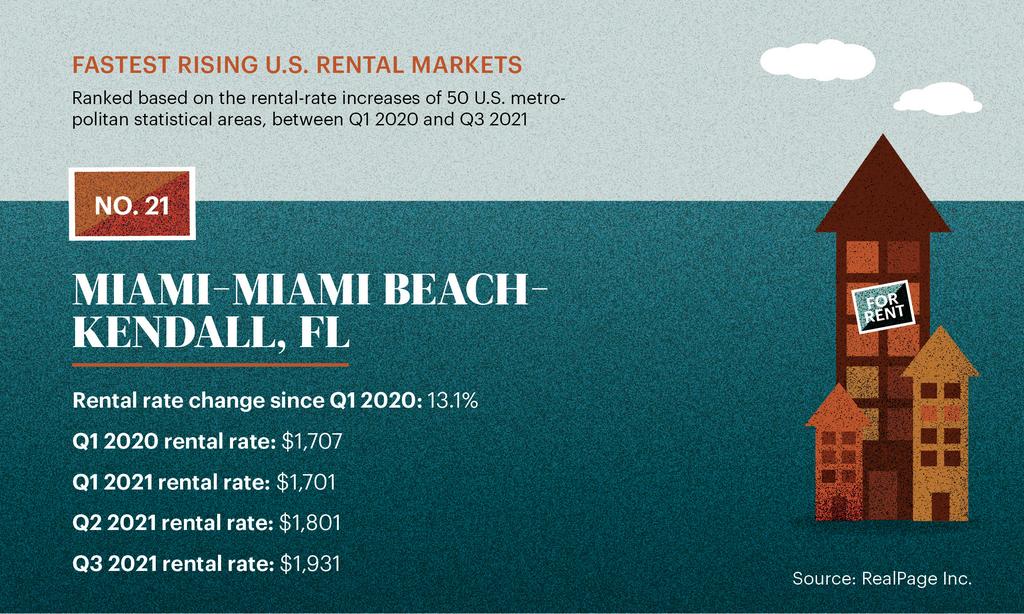
But, in 14 of the 50 metro areas analyzed by Realtor.com, rent share was higher than 30% of the median household income. In February 2022, Miami was identified as the least-affordable rental market, with a median rent of $2,929, a 55.3% increase from February 2021. A typical household income there would’ve spent 59.5% of their monthly paycheck on a typical rental in February 2022.
Affordable monthly rent for Realtor.com was calculated by applying the 30% rule to monthly median household income in each metro area examined.
The U.S. Department of Housing and Urban Development considers a household paying in excess of 30% of their income for housing to be cost-burdened, suggesting rent hikes are creating additional pressure for rental households. Wage increases largely aren’t keeping pace.
Danielle Hale, chief economist at Realtor.com, said the annual increase in February decelerated from a month prior, but not by much — 17.2% versus 17.1%. The company is still forecasting the rate of rental growth to continue to slow in 2022, but nonetheless is expected to grow in the coming months.
“Rents are still high, and they’re growing to new highs,” Hale said. “You’re going to see higher rental costs each month, but the pace of the growth isn’t going to be as much.”
The Sun Belt, in particular, has gotten more expensive the fastest, with 23 of 50 metro areas examined by Realtor.com seeing an average year-over-year growth rate of 22.5%, between February 2021 and February 2022.
The correlation between the rental and for-sale market also means, if households desire homeownership, it’s becoming increasingly out of reach as costs associated with renting a unit continue to grow.
It’s more anecdotal but Pinata, a Newark, New Jersey-headquartered company that creates a rewards app for renters, found 64% of renters it recently surveyed reported being unable to save any money, let alone for a down payment. Less than 10% of renters surveyed said they were currently saving more than $500 a month.
A similar story is playing out specifically within the single-family rental market, a booming sector since Covid-19. Single-family rents increased 12.6% in January 2022, according to Irvine, California-based property-data company CoreLogic Inc. That’s the fastest year-over-year increase in more than 17 years, and the 10th consecutive month of a new record being achieved in CoreLogic’s Single-Family Rent Index.
Within this subsector of multifamily housing, Miami also came out on top, with 38.6% year-over-year rent growth for single-family rentals, CoreLogic found. Orlando, Florida, followed, with 19.9% annual growth.
Rent growth for studios, one-bedroom apartments and two-bedroom apartments grew at about the same pace year over year in February, Realtor.com found. But when looking at a two-year timeframe, studio rents have grown a more modest 11.7%, compared to 17.1% for one-bedroom apartments and 21.2% for two-bedroom units.
Hale said that’s likely because of the leasing slump studio units saw in 2020, when urban dwellers relocated out of dense cities. That migration back to city centers, where studios tend to be clustered, began happening last year, prompting a 17.1% annual growth for studio units nationally between February 2021 and February 2022.
Population trends — including a growing number of household formation, among millennials and Gen Z — the pandemic and inflation are all contributing to the rapid growth of rental housing costs, Hale said. Costs for owning, operating and maintaining a rental property have also gone up, which landlords pass down to renters.
Source: https://bit.ly/3izKZUi